What Is an Odds API?
An odds API is a programmatic interface that delivers real-time and historical betting odds from sportsbooks to your application. Instead of scraping bookmaker websites or maintaining direct partnerships with dozens of operators, you make a single HTTP request and receive structured JSON containing moneylines, spreads, totals, and prop markets across every major sport.
The core value proposition is aggregation. A typical odds API pulls data from 30 to 250+ bookmakers, normalizes the formats, and serves it through one consistent schema. That means you can compare lines from DraftKings, FanDuel, BetMGM, and Bet365 in the same API response without building separate integrations for each.
For a deeper comparison of specific providers, see Best Sports Betting APIs Compared (2026).
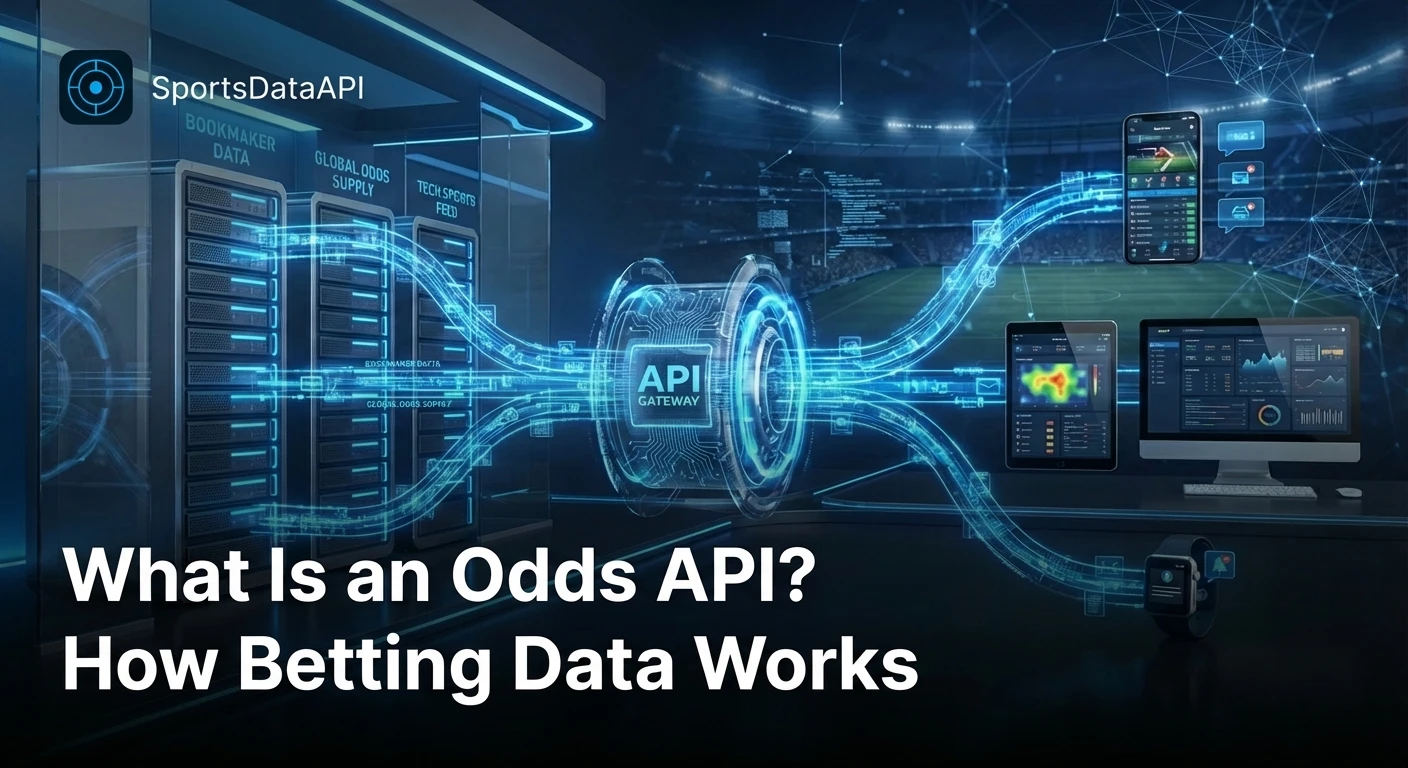
How It Works: Data Flow from Bookmakers to Your App
The data pipeline from a sportsbook to your application follows a predictable path:
- Bookmakers set opening lines using a combination of manual trading expertise, algorithmic pricing models, and official data partnerships. These odds reflect implied probabilities for each outcome.
- Data providers connect to bookmaker feeds through direct partnerships, official APIs, or licensed data agreements. They ingest odds across all markets: pre-match, in-play, futures, and props.
- The aggregation layer normalizes the incoming data. This means assigning universal event identifiers, standardizing team and player names, converting between odds formats, and tagging each price with the originating bookmaker and timestamp.
- Delivery happens through two mechanisms. REST APIs handle request-response workflows suitable for pre-match odds and historical data. WebSocket connections provide continuous streaming for live in-play markets where milliseconds matter.
- Your application receives clean JSON. Each response typically contains the event metadata (sport, league, teams, start time) and an array of bookmaker objects, each holding their current prices for the requested market.
This entire cycle, from a bookmaker adjusting a line to that change appearing in your API response, takes anywhere from under one second (via WebSocket) to around 30 seconds (via polling a REST endpoint).
Who Uses It: Developers, Bettors, and Data Analysts
Odds APIs serve three primary audiences:
- Developers building betting apps, odds comparison sites, or fantasy sports platforms. The API replaces months of custom scraping and data normalization work.
- Bettors and tipsters who want to track line movement, find the best available price, or identify arbitrage opportunities across sportsbooks.
- Data analysts and researchers using historical odds data to build prediction models, backtest strategies, or study market efficiency.
Key Features and Data Points
Odds Formats: American, Decimal, Fractional
Most odds APIs return data in multiple formats. You typically set a parameter like oddsFormat in your request to choose between them:
- Decimal (2.10): Standard in Europe and Australia. Multiply your stake by the decimal number to calculate total payout. A $100 bet at 2.10 returns $210.
- American (+110 / -150): Standard in North America. Positive numbers show profit on a $100 bet. Negative numbers show how much you must bet to win $100.
- Fractional (11/10): Traditional UK format. The numerator is profit relative to the denominator as stake.
All three formats represent the same underlying probability. For a detailed breakdown of converting between them, see Odds Formats Explained: American, Decimal, and Fractional.
Markets Covered: Moneyline, Spreads, Totals, Props
The major market types you can expect from a well-rounded odds API:
- Moneyline (h2h): The simplest bet. Pick which team wins. Three-way moneylines include the draw for sports like soccer.
- Spreads (handicaps): One team is given a point advantage or disadvantage. The spread must be covered for the bet to win.
- Totals (over/under): A combined score threshold set by the bookmaker. You bet whether the actual total lands over or under that number.
- Props (player and game props): Individual player performance markets like “Player X to score over 25.5 points” or game-level propositions like “first team to score.”
- Outrights (futures): Season-long markets such as “Super Bowl winner” or “Premier League champion.”
Update Frequency and Latency
How fast odds data refreshes depends on the provider and your subscription tier:
- Pre-match odds typically update every 30 to 60 seconds through REST endpoints.
- Live in-play odds update continuously via WebSocket, with leading providers advertising sub-second latency for primary markets.
- Historical snapshots are commonly available at 5-minute intervals, useful for backtesting and line movement analysis.
Latency matters most for live betting and arbitrage detection. Even a few seconds of delay can mean the difference between capturing a profitable opportunity and hitting a stale line.
Common Use Cases
Building a Betting App or Dashboard
The most straightforward use case. You pull odds from the API and display them in a clean interface that lets users compare lines across bookmakers, track line movement, and find the best available price for any given event.
A typical dashboard fetches upcoming events for a sport, renders the odds in a sortable table, and highlights which bookmaker offers the best price for each outcome. Many operators use this pattern for odds comparison websites that monetize through affiliate links to sportsbooks.
Odds Comparison and Arbitrage Detection
Arbitrage (or “arbing”) exploits pricing discrepancies between bookmakers. When the combined implied probability across all outcomes drops below 100%, a guaranteed profit exists regardless of the result.
An odds API makes this feasible at scale. You poll the API for all available prices on an event, calculate the combined implied probability, and flag opportunities where the math works out. Automated systems can scan hundreds of events per minute and alert users the moment an arbitrage window opens.
The window for most arbitrage opportunities is short, often just seconds. This is why update frequency and low latency are critical features when choosing an API provider for this use case.
Sports Analytics and Prediction Models
Closing line data from odds APIs is widely regarded as the most efficient predictor of game outcomes. Researchers use historical odds to:
- Train machine learning models that predict game results
- Backtest betting strategies against actual market prices
- Measure the accuracy of their own models against the market consensus
- Study how odds move in response to news, injuries, and public betting patterns
If you are building a prediction pipeline, the combination of an odds API for market data and a stats API for player and team performance data creates a robust foundation. For a hands-on walkthrough, see How to Use an Odds API with Python (Step-by-Step).
How to Get Started
Choosing an API Provider
The right provider depends on your use case, budget, and technical requirements. Key factors to evaluate:
- Bookmaker coverage: How many sportsbooks does the API aggregate? More bookmakers mean more comparison data and better arbitrage detection.
- Sports and market depth: Some APIs focus on major US sports while others cover international leagues, esports, and niche markets.
- Latency and delivery method: REST-only APIs work fine for pre-match data. If you need live in-play odds, look for WebSocket support.
- Historical data availability: Essential for backtesting and model training. Not all providers include this.
- Rate limits and pricing: Match the plan to your request volume. Overage charges can add up quickly.
Authentication and API Keys
Nearly every odds API uses API key authentication. The typical onboarding flow:
- Sign up on the provider’s website
- Receive an API key via email or in your dashboard
- Include the key in every request, either as a query parameter (
?apiKey=YOUR_KEY) or in the request header (Authorization: Bearer YOUR_KEY)
Keep your API key private. Never expose it in client-side JavaScript or public repositories. Store it in environment variables or a secrets manager.
Making Your First Request
A basic request to an odds API follows this pattern:
GET https://api.example.com/v4/sports/basketball_nba/odds
?apiKey=YOUR_KEY
®ions=us
&markets=h2h,spreads
&oddsFormat=americanThe response returns a JSON array where each object represents a game. Inside each game object, you find an array of bookmakers, and inside each bookmaker, an array of markets with their current prices:
{
  "id": "abc123",
  "sport_key": "basketball_nba",
  "home_team": "Los Angeles Lakers",
  "away_team": "Boston Celtics",
  "commence_time": "2026-02-15T00:00:00Z",
  "bookmakers": [
    {
      "key": "draftkings",
      "markets": [
        {
          "key": "h2h",
          "outcomes": [
            { "name": "Los Angeles Lakers", "price": -150 },
            { "name": "Boston Celtics", "price": +130 }
          ]
        }
      ]
    }
  ]
}
Most providers include usage headers in the response (like x-requests-remaining) so you can track your consumption against your plan limits.
Pricing and Free Tier Options
Most odds API providers offer a free tier for testing and development, with paid plans scaling by request volume:
- Free tiers typically provide 100 to 500 requests per day or month. Enough to prototype an application and verify the data format meets your needs, but not enough for production use.
- Starter plans range from $10 to $30 per month and cover light production workloads or personal projects.
- Mid-tier plans run $50 to $120 per month and support moderate request volumes with access to all sports and markets.
- Enterprise plans start around $250 per month and include premium features like WebSocket streaming, historical data access, dedicated support, and higher rate limits.
Some providers charge per request while others use a monthly credit system where different endpoints consume different amounts of credits. Check whether live in-play data, historical odds, and player props are included in your plan or billed separately.
FAQ
Is there a free odds API?
Yes. Several providers offer free tiers that let you make a limited number of requests per day or month at no cost. These free plans typically include access to all sports and markets but cap your request volume. They work well for development, testing, and personal projects. For production applications with real traffic, you will need a paid plan.
What sports does an odds API cover?
Coverage varies by provider, but major odds APIs support 25 to 40+ sports. The standard list includes NFL, NBA, MLB, NHL, soccer (Premier League, La Liga, Bundesliga, Serie A, MLS, and more), tennis, golf, MMA, boxing, cricket, rugby, and motorsports. Some providers also cover esports, table tennis, darts, and other niche markets. Check the provider’s sports endpoint to see their full list.
How often does odds API data update?
Pre-match odds typically refresh every 30 to 60 seconds via REST endpoints. Live in-play odds update continuously through WebSocket connections, with leading providers delivering sub-second latency. Historical odds snapshots are usually available at 5-minute intervals. The exact update frequency depends on your provider and subscription tier, with higher plans generally offering faster refresh rates and access to real-time streaming.